 Recommendation strength: 10/10
Recommendation strength: 10/10
You should read this if:
Your phone is set to silent, you have prepared a large flask of coffee, and have readied your favourite armchair for many hours of deep reflection on what knowledge is, how it’s created, and its infinite capability to solve problems.
My thoughts:
Formidably erudite and yet eminently readable, Deutsch helped me become more tolerable in conversation through his convincing account of the virtues of fallibilism (i.e. the recognition that there are no authoritative sources of knowledge, nor any reliable means of justifying ideas as being true or probable). “Fallibilists expect even their best and most fundamental explanations to contain misconceptions in addition to truth, and so they are predisposed to try to change them for the better.” Too often I find myself vehemently defending positions that I have (sometimes knowingly, but more often subconsciously) lifted directly from sources of authority that I trust and that align with my worldview. But nobody wants to debate someone unprepared to entertain ideas that challenge their own. Isn’t it more energising to speak with someone open-mindedly and genuinely curious to rectify their inevitable misconceptions? Rather than asserting misconceptions as facts, what I should be doing is seeking good explanations. That’s what this book is about.
A good explanation is hard to vary while still accounting for what it purports to account for. Put another way, the structure of a good explanation cannot be changed without affecting its ability to make sense of the phenomenon it seeks to explain. In contrast, “the seasons are the result of an ongoing battle between the fire god and the ice god” is a bad explanation, because the battle could easily be replaced with “the sun god becomes angry with humans each year and refuses to raise the sun high in the sky, causing winter,” without loss of explanatory power. The axial tilt theory of the Earth is a good explanation because it is hard to vary in this structural sense. Changing from a tilted rotation axis to one perpendicular to the orbital plane would break the explanation’s explanatory power, as a vertical rotation axis would result in consistent local weather year-round (i.e., no seasons). Good explanations require both creativity (making guesses that can be exposed to criticism) and criticism (testing those guesses with logic, reason, or experimentation).
Creating good explanations contributes to the growth of knowledge, and there is no known limit to what knowledge created in this way can explain, and therefore achieve. In Deutsch’s words: “if something is permitted by the laws of physics, then the only thing that can prevent it from being technologically possible is not knowing how.” We also need sufficient time, resources, and error correction, but this is the basis for his assertion that optimism is rational, and that most evils persist through insufficient knowledge. Far from arguing blind faith that “things will work out” is rational, this is a recognition that problems are inevitable, but soluble. It is not an argument that optimism guarantees progress or success within a given timeframe, avoidance of risk or suffering, or is morally ‘good’.
Given the prevalence of compellingly-clickable apocalyptic and prophetic headlines, it is tempting to lament present-day challenges as inherently insurmountable, but this is a fallacy. With the right knowledge, time, and resources, we can resolve any problem that is not prevented by the laws of physics. This fundamentally changed my mindset. Deutsch explains: “society is not a zero-sum game: the civilization of the Enlightenment did not get where it is today by cleverly sharing out the wealth, votes or anything else that was in dispute when it began. It got here by creating ex nihilo.” Problems lead to new problems, but that should not lead to despair. We grow the pie by solving problems. To expect that solutions will always be found in time to avert disasters is a fallacy, but so is giving up hope altogether. The burden of proof for justifying pessimism is much higher than for optimism. We shouldn’t mistake “we don’t currently know how” for “it can’t be done”. Even failed attempts at creating good explanations create knowledge (i.e. of what doesn’t work).
Other extracts from the book which challenged my beliefs include:
- “Changing our genes in order to improve our lives and to facilitate further improvements is no different in this regard from augmenting our skin with clothes or our eyes with telescopes.”
- “Biological evolution does not optimize benefits to the species, the group, the individual or even the gene, but only the ability of the gene to spread through the population.” (I’ve added The Selfish Gene to my reading list)
- “Like scientific theories, policies cannot be derived from anything. They are conjectures. And we should choose between them not on the basis of their origin, but according to how good they are as explanations: how hard to vary.”
- “The evil of death - that is to say, the deaths of human beings from disease or old age. This problem has a tremendous resonance in every culture - in its literature, its values, its objectives great and small. It also has an almost unmatched reputation for insolubility (except among believers in the supernatural): it is taken to be the epitome of an insuperable obstacle. But there is no rational basis for that reputation. It is absurdly parochial to read some deep significance into this particular failure, among so many, of the biosphere to support human life - or of medical science throughout the ages to cure ageing. The problem of ageing is of the same general type as that of disease. Although it is a complex problem by present-day standards, the complexity is finite and confined to a relatively narrow arena whose basic principles are already fairly well understood.”
- “Even different electrons do not have complete separate identities.”
- “When a piece of music has the attribute ‘displace one note and there would be diminishment' there is an explanation: it was known to the composer, and it is known to the listeners who appreciate it” ... “if I am right, then the future of art is as mind-boggling as the future of every other kind of knowledge: art of the future can create unlimited increases in beauty.”
This book is dense with insight. I’ll admit that I found many concepts challenging, but with liberal use of LLMs to provide alternate explanations, I finished each chapter with at the very least a little intellectual morsel to chew on over the subsequent days. I’ll be revisiting this book in a few months, or years, when the torrent of steam that is currently emanating from the skin above my poor, overworked prefrontal cortex has dissipated, and I have nourished and rejuvenated my mind with a few gentle novels.
Here for full book extracts.
 Recommendation strength: 9/10
You should read this if:
You are a productivity zealot with a growing suspicion that implementing ever more efficient methodologies to optimise your life and work might not cure your existential angst after all.
My thoughts:
Those unchallenged assumptions about what makes a meaningful and fulfilling life (busyness, achievements, doing more things) are systematically stripped away in this ruthless assault on our increasingly pervasive productivity culture. After learning that the average human lifespan is an insultingly short four thousand weeks, I was expecting a litany of the many ways we should all be maximising the little time we have on this earth, squeezing every last drop of juice from the meagre offering of conscious experience bestowed on each of us before death comes knocking.
Refreshing, then, to receive the opposite message: that it is impossible to do everything we want to do, so there is really no point in trying. In fact, accepting our limitations is an ironically liberating exercise. When we free ourselves from the unrealistic expectation that we can squeeze more and more into our packed schedules (suffering the fatigue and burnout that inevitably follow), we open the door to mindfully enjoying doing the few things we initially set out to do.
In truth, I often felt defensive reading this book. I suffer from perennial unrealistic expectations about how much I can achieve (the negative side of the double-edged sword of optimism). When reality refuses to comply with those expectations, I’m often left feeling dejected. This book invited me to let go of those expectations and embrace my human limits. To accept them with curiosity and compassion, rather than frustration. It’s ok that your to do list isn’t shrinking. In a few lifetimes, nobody will remember anyway.
A few of my favourite extracts:
The paradox of limitation: ... the more you try to manage your time with the goal of achieving a feeling of total control and freedom from the inevitable constraints of being a human, the more stressful, empty and frustrating life gets, but the more you confront the fact of finitude instead, the more productive, meaningful and joyful life becomes.
Fulfilment might lie in embracing, rather than denying, our temporal limitations.
The 'efficiency trap': rendering yourself more efficient - either by implementing various productivity techniques or by driving yourself harder - won't generally result the feeling of having more time, because all else being equal - the demands will increase to offset any benefits. Far from getting things done - you'll be creating new things to do.
It is by consciously confronting the certainty of death, and what follows from the certainty of death, that we finally become truly present for our lives.
The paradoxical reward for accepting reality's constraints, is that they no longer feel so constraining.
Our expectations are forever rubbing up against the stubborn reality that time isn't in our possession, and can't be brought under our control.
All a plan is, all it could ever possibly be, is a present moment statement of intent. It's an expression of your current thoughts about how you'd ideally like to deploy your modest influence over the future. The future, of course, is under no obligation to comply.
[On parenting with a future-optimising mindset] Maybe it really is a bad habit, as the baby trainers insist, for your one-year-old to grow accustomed to falling asleep on your chest. But it's also a delightful experience in the present moment and that has to be weighed in the balance. It can't be the case that concerns for the future must always automatically take precedence.
To "try" to live in the moment implies that you are somehow separate from the moment, and thus in a position to either succeeded or fail at living in it.
Living more fully in the present may simply be a matter of finally realising that you have no other option, but to be here, now.
The truth, then, is that spending at least some of your leisure time 'wastefully', focused solely on the pleasure of experience, is the only way not to waste it, to be truly at leisure, rather than covertly engaged in future-focused self improvement.
A country walk, like listening to a favourite song or meeting friends for an evening of conversation, is thus a good example of what the philosopher Kieran Setiya calls an “atelic activity,” meaning that its value isn’t derived from its telos or ultimate aim.
We might seek to incorporate into our daily lives more things we do for their own sake alone – to spend some of our time, in other words, on activities in which the only thing we’re trying to get from them is the doing itself.
As you dive into life as it really is, in clear-eyed awareness of your limitations, you begin to acquire what has become the least fashionable, but perhaps most consequential of superpowers: patience.
Time is also a "network good", one that derives its value from how many other people have access to it too, and how their portion is coordinated with yours.
You can grasp the truth that power over your time isn't something best hoarded entirely for yourself; that your time can be too much your own.
A blunt, but unexpectedly liberating truth: that what you do with your life doesn't matter that much, and when it comes to how you're using your finite time, the universe absolutely could not care less.
The Ancient Egyptians lived 35 centenarian lifetimes ago, the Romans 20.
No wonder it comes as a relief to be reminded of your insignificance. It's the feeling of realising that you've been holding yourself, all this time, to standards you couldn't reasonably be expected to meet and this realisation isn't merely calming, but liberating because once you're no longer burdened by such an unrealistic definition of a life well spent, you're free to consider the possibility that a far wider variety of things might qualify as meaningful ways to use your finite time.
Procrastination, distraction, commitment phobia, clearing the decks, and taking on too many projects at once are all ways of maintaining the illusion that you are in charge of things.
Carl Jung : "Quietly do the next and most necessary thing"
 Recommendation strength: 9/10
You should read this if:
Lke me, you are an economics muggle who wants a basic understanding of the economic themes and jargon you read in the news. If you studied economics previously, this book will be less valuable, but you may still enjoy the facts and anecdotes peppered throughout (e.g. that falling sales of men’s underwear is a good indicator of recession).
My thoughts:
A succinct overview of economics, covering supply and demand, markets, growth, inflation, money, banks, crises, and more. Each chapter addresses an economic concept by answering a common question (like “can’t we just print more money?”) in simple language, supported by endearing anecdotes and curious facts that bring the subject to life. The authors are economists at the Bank of England, meaning references tend to be Anglocentric. That may be a turn-off for those who didn’t grow up eating Freddo chocolate frogs purchased from Woolworths, but had me smiling and nodding along.
Having never studied economics, this book drew together many nebulous concepts that previously floated around my head on disparate islands (inflation, interest rates, growth, etc.), weaving a comprehensive and cohesive foundation of economic understanding. Armed with that understanding, I’m now more confident to read about and discuss contemporary economic issues with friends and family. You might justifiably deride me for not already knowing this stuff at the ripe old age of 33. Better late than never, I suppose.
Perhaps it was all the jargon I read in the news, or my complexity bias, but I never appreciated how much economics effects, and is affected by, everything you and I do, no matter how seemingly mundane. Feeling a part of it has kindled my interest. As the authors suggest, economics "is everything: the cumulative effect of all of the billions of decisions that humans make every day, and the way they interact with everything else in the world".
A few of my favourite extracts:
All models are wrong, but some are useful (George Box).
Markets, like all of us, are far from perfect. They fail to adequately internalise the costs of people's actions, leading to the over-consumption of finite resources ... they also lead to the underproduction of useful things, like education, and the overproduction of harmful things, like carbon dioxide.
The US-China trade war that began in 2018 harmed not just the two countries directly involved, but the whole world. At the time, it was expected to lower US and China's GDP by early 2 per cent, and global GDP by around 16 per cent.
The first national lottery in England came in 1567 ... the first prize was £5,000 - with some bonus prizes including plates, tapestries and, naturally, immunity from prosecution.
The theory goes that what we think will happen to inflation is one of the big determinants of what actually does happen. Inflation can be a self-fulfilling prophecy.
At its core, money is trust. Money works because we all agree, as a society, that it has value.
Even as recently as 2009, huge wheels of Parmesan cheese could be used as a deposit for a loan in parts of Italy.
The bulk of the money we use every day, in the form of bank deposits, is nothing more than a promise by our bank to pay us back, created out of thin air when they lend.
Scottish banknotes are not a direct claim on the Bank of England - they are privately issued … however, they do have to be backed one-for-one by money held at the Bank of England. To make this possible, the Bank's vaults contain notes called Giants, each worth £1 million, and Titans, each worth £100 million.
Today there are around 400,000 bars of gold worth over £200 billion stored in the Bank of England’s vaults. This amounts to a fifth of all the gold in the world.
In the UK there are over £8 million worth of money transactions made per second - £700 billion worth of exchanges between bank accounts every single day.
We all believe that banks keep our money safe, and for the most part they do. But if for a moment we all stopped believing that banks are safe - and tried to take that money out - the whole system would collapse.
One of the most accurate short-term predictors of a downturn is the number of articles in the New York Times and the Washington Post in which the word 'recession' appears.
 I started this book hoping (perhaps naïvely) to finish with an understanding of the general meaning of my life. Using the analogy of a film (where each frame represents each moment in life), Frankl argues that the general meaning of a life only becomes clear when the whole thing has been lived, so rather than searching for a general meaning now, we might be better served by searching for the meaning in each moment (or 'frame' of the film) that we live.
How? Frankl argues that we are free to choose our attitude in response to any circumstances, however dire* (he might well be regarded authoritative on this point, having been imprisoned in four Nazi concentration camps), and that - armed with this credo - we can find meaning through: (1) creating a work or doing a (virtuous) deed; (2) experiencing or encountering someone (doing something or being with someone you love); or (3) enduring unavoidable suffering. We are warned against relying solely on the first option (which risks conflation of external validation with meaning), reminded of the virtues of finding meaning via the second, and advised that enduring avoidable suffering is masochistic - not heroic.
In seeking meaning, Frankl invites us to act responsibly and in accordance with our (presumably virtuous) values. Not to think: "what do I want / what can I get from this situation?", but rather 'what does life expect of me in this situation?' - and then taking that action.
These are the teachings of Frankl's 'logotherapy' (from the Greek 'logos', meaning 'meaning'). Logotherapy invites its subjects to look to the future (i.e. choosing actions and finding meaning) rather than to the past (i.e. analysing trauma) to soothe 'existential vacuum' and help overcome psychic pain. It reminds me of Alfred Adler's concept of 'contribution to Community' and focus on our 'life tasks' to mitigate existential angst and attain tranquility.
My take: we can find meaning in each moment of our life if we strive for the most responsible action that aligns with our (virtuous) values. That might be something as momentous as applying brushstrokes to a magnificent canvas, or as banal as doing the dishes (even when it's not your turn). In practice, it probably means dedicating meaningful time toward a creative pursuit, spending quality time with loved ones, and bravely and mindfully weathering the storm of unavoidable suffering (when it inevitably arises). I find this idea compelling and will experiment with implementing these tenets of logotherapy in my own life over the coming months.
*In defence of this assertion, Frankl points to his experience in concentration camps, where some prisoners acted ruthlessly toward their fellow inmates, while others acted with grace and selflessness, despite experiencing the same horrendous conditions. I couldn't help but question whether the life experiences and mental constitution of the prisoners before they entered the camps might have had some impact on whether they turned out to be a 'swine' or a 'saint'. Is this really proof that to act in a good or evil way is always a choice? That anyone demonstrated selflessness in spite of the cold, hunger, cruelty, and illness rife in Nazi concentration camps perhaps shows that at least some humans are able to choose between good and evil regardless of their conditions.
A few of my favourite extracts:
“Don’t aim at success—the more you aim at it and make it a target, the more you are going to miss it. For success, like happiness, cannot be pursued; it must ensue, and it only does so as the unintended side-effect of one’s dedication to a cause greater than oneself or as the by-product of one’s surrender to a person other than oneself."
"Everything can be taken from a man but one thing: the last of the human freedoms—to choose one’s attitude in any given set of circumstances, to choose one’s own way."
"Logotherapy conceives of conscience as a prompter which, if need be, indicates the direction in which we have to move in a given life situation."
"People tend to see only the stubble fields of transitoriness but overlook and forget the full granaries of the past into which they have brought the harvest of their lives: the deeds done, the loves loved, and last but not least, the sufferings they have gone through with courage and dignity."
 p.36 Everlasting misfortune does have one blessing, that it ends up by toughening those whom it constantly afflicts.
p. 38 It was nature's intention that there should be no need of great equipment for a good life; every individual can make himself happy. External goods are of trivial importance and without much influence in either direction: prosperity does not elevate the sage and adversity does not depress him. For he has always made the effort to rely as much as possible on himself and to derive all delight from himself.
p. 39 Never have I trusted Fortune, even when she seemed to offer peace. All those blessings which she kindly bestowed on me - money, public office, influence - I relegated to a place whence she could claim them back without bothering me. I kept a wide gap between them and me, with the result that she has taken them away, not torn them away. No man has been shattered by the blows of Fortune unless he was first deceived by her favours. Those who loved her gifts as if they were their own for ever, who wanted to be admired on account of them, are laid low and grieve when the false and transient pleasures desert their vain and childish minds, ignorant of every stable pleasure. Everything (even the sun and stars) is changing all the time, we should delight in novelty rather than rail against it.
p. 44 So fate has decreed that nothing maintains the same condition forever
p. 45 only the most worthless of our possessions should come into the power of another. Whatever is best for a human being lies outside human control: it can be neither given nor taken away. The world you see, nature's greatest and most glorious creation, and the human mind which gazes and wonders at it, and is the most splendid part of it, these are our own everlasting possessions and will remain with us as long as we ourselves remain.
p. 48-49 The body's needs are few: it wants to be free from cold, to banish hunger and thirst with nourishment; if we long for anything more we are exerting ourselves to serve our vices, not our needs. We do not need to scour every ocean, or to load our bellies with the slaughter of animals, or to pluck shellfish from the unknown shores of the furthest sea.
p 52-53 It is the mind that creates our wealth, and this goes with us into exile, and in the harshest desert places it finds sufficient to nourish the body and revels in the enjoyment of its own goods. Money in no way concerns the mind any more than it concerns the gods. All those things which are revered by minds untaught and enslaved to their bodies - marble, gold, silver, great round polished tables - are earthly burdens which a soul pure and conscious of its nature cannot love: for it is light and unencumbered, and destined to soar aloft whenever it is released from the body.
p. 59 For to be afflicted with endless sorrow at the loss of someone very dear is foolish self-indulgence, and to feel none is inhuman callousness. The best compromise between love and good sense is both to feel longing and to conquer it.
p.61 I know that this is not something which is in our power and that no strong feeling is under our control, least of all that which arises from sorrow: for it is violent and violently resists every remedy. Sometimes we want to crush it and swallow down our groans, but through the pretended composure of our features the tears pour down. Sometimes we divert our mind with public shows or gladiatorial contests, but in the very midst of the distractions of the spectacles it is undermined by some little reminder of its loss. Therefore it is better to conquer our grief than to deceive it. For if it has withdrawn, being merely beguiled by pleasures and preoccupations, it starts up again and from its very respite gains force to savage is But the grief that has been conquered by reason is calmed forever.
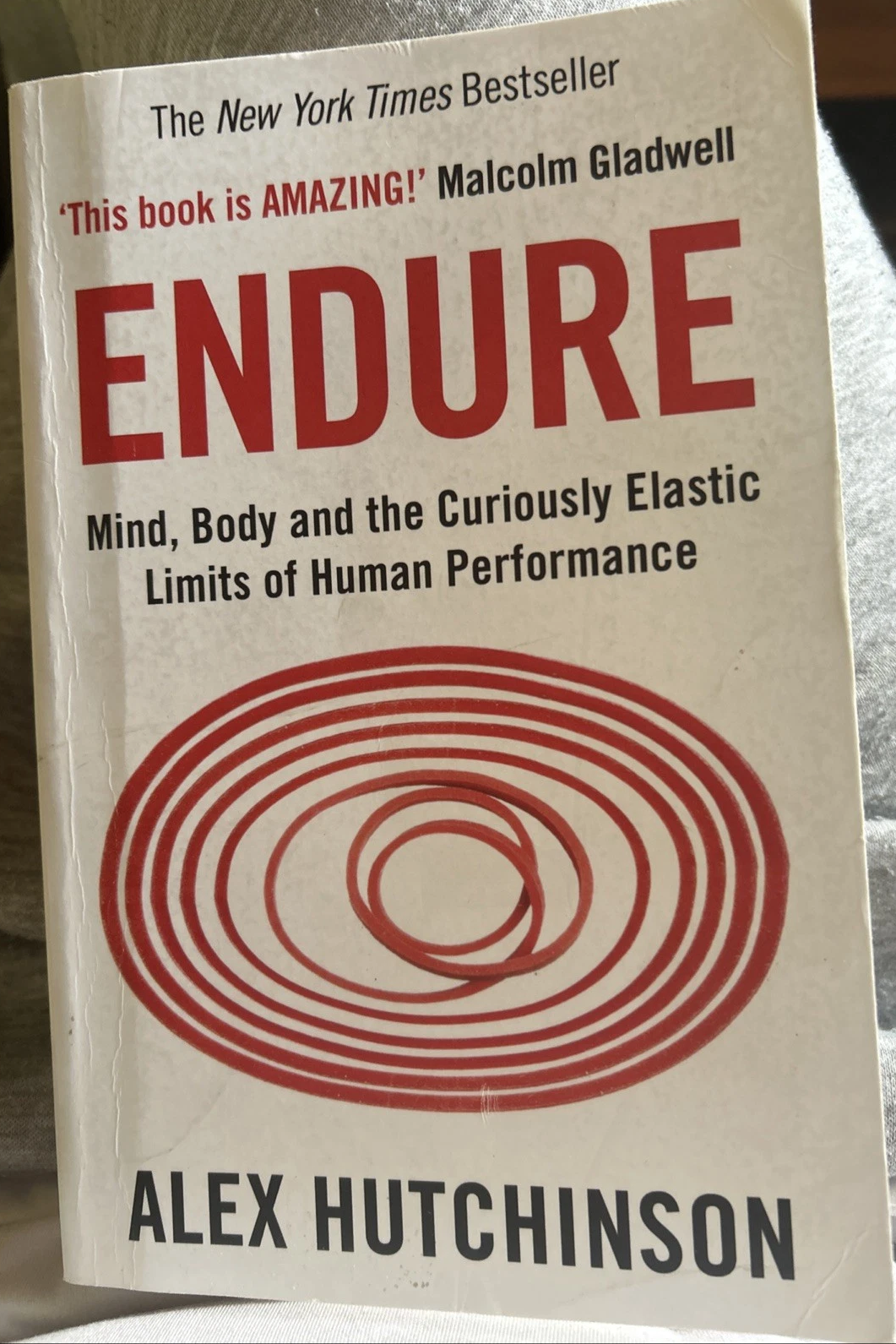 Recommendation strength: 8/10
You should read this if:
Using your body to move quickly or go far appeals to you and you’re curious as to what might help you do either, or both, better.
My thoughts:
Frowning makes cycling feel harder. You can store about 400-500 grams of glycogen in the liver and around 2,000 grams in fully-loaded legs. Cycling at a power of 250w concurrently releases around 1000w of energy as heat. I am armed with countless facts to impress (or, perhaps, bore) friends and family around the dinner table (unless they are also endurance nerds), but the real gold of this book was the final section: the impact of the mind on performance.
Assuring golfers that a ball “has so far turned out to be a lucky ball” increased putting accuracy by 33% compared with a ball “that everyone else has used”. Improving performance by believing that performance will improve is not limited to superstition. The cumulative effect of combining supplementation and recovery modalities which each have a demonstrated 1-3% positive impact on performance tends to result in an aggregate performance improvement of … 1-3%, suggesting a placebo effect is at play. If you expect your recovery or performance to improve as a result of a specific modality, that expectation is likely to be self-fulfilling. That may be why athletes insist on ice baths, massage, percussive therapy, foam rolling, and stretching, despite the dearth of robust evidence of any objective physiological benefit. In short, if you convince yourself something will improve performance (be it lucky underwear or beetroot juice), it probably will. Just don’t expect the benefits to stack.
The classic variables that impact endurance (pain, fatigue, heat, water, and food) are analysed in satisfying detail, with thoughtful anecdotes translating the cold data into relatable narrative. There is no shortage of practical insights: I was relieved to discover that drinking to thirst (rather obsessing over the minutiae of a complex hydration strategy) will serve you well in most contexts - a notable exception being extreme heat. Heat training to prepare for events in warmer climes also seems rooted in sound theory, with corroborating studies. And a soothing sensation of relief accompanied the section which settled the low-carb, high-fat vs high-carb, low-fat diet argument, in favour of the latter.
That the preceding pages comprised a snapshot in the continuing development of our understanding of exercise physiology was acknowledged gracefully in closing. It’s exciting that we still have much to learn. With writers as adept as Hutchinson in condensing the studies into a digestible and enjoyable formats, learning about this subject ironically requires little endurance on the part of the reader.
A few of my favourite extracts:
Pain
If I could go back in time to alter the course of my own running career, after a decade of writing about the latest research in endurance training, the single biggest piece of advice I would give to my doubt-filled younger self would be to pursue motivational self-talk training—with diligence and no snickering.
For millions of people around the world, endurance challenges are somewhere between a hobby and an addiction, a form of grueling self-test that has no particular health justification. Why? If races were really just plumbing contests—tests of whose pipes could deliver the most oxygen and pump the most blood—they would be boringly deterministic. You race once, and you know your limits. But that’s not how it works.
the distinction between physical and psychological endurance is actually less clear-cut than it appears.
The number of contractions they managed after three and a half hours of grilling their students was dramatically reduced compared to their baseline performance—a clear indication that “intellectual labor” had sapped their muscular endurance.
Marcora used EMG electrodes to record the activity of facial muscles while subjects lifted leg weights or cycled, and found a strong link between reported effort and the activation of frowning muscles during heavy exercise.
But there were two key differences between the groups. First, pain tolerance increased by 41 percent in the high-intensity group, while the medium-intensity subjects didn’t see any change. This shows that simply getting fitter doesn’t magically increase your pain tolerance; how you get fit matters: you have to suffer.
But it suggests that, at least in recreational athletes, pain tolerance is both a trainable trait and a limiting factor in endurance.
The results suggested that the pain you experience in the extremes of sustained exercise is fundamentally different, from your brain’s perspective, from the pain you experience while dunking your hand in ice water. All pleasure is alike, as Leo Tolstoy might have put it, but each pain hurts in its own unique way.
The experiments that Alexis Mauger and Samuele Marcora have done trying to untangle the difference between “pain” and “effort” make me think that pain, in most contexts, is a warning light on the dashboard. It instructs you (sometimes very insistently) to slow down, and in most contexts you heed that warning without even realizing you’re doing it. But it’s not an absolute limit. For that, we have to look elsewhere.
Fatigue
Trying to make a clean divide between “brain fatigue” and “muscle fatigue,” in other words, is inevitably an oversimplification, because they’re inseparably linked.
Top athletes, far from being immune to lactate, are actually able to recycle it into fuel more efficiently than lesser athletes.
The results suggest that lactic burn isn’t literally the feeling of acid dissolving your muscles; instead, it’s a cautionary signal created in the brain by nerve endings that are triggered only in the presence of three key metabolites.
But in a diverse group of people, you can reliably assume that those with higher VO2max will outperform those with lower values in tests of endurance, even at long distances like a half-marathon where no one actually reaches their VO2max.
“[P]sychology,” they wrote, “is a special case of brain physiology.” In other words, feelings and emotions and urges are as physiologically real as changes in core temperature or decreases in hydration, and are mediated by chemical signals. So when oxygen levels in the brain drop, are we compelled by failing neurons or safety circuitry to slow down, or do we simply decide to slow down? Is there a difference? Whatever the answers (and I don’t think we know them at this point), the outcome is clear. We slow down.
Heat
For every 100 calories of food you eat, in other words, you might get 25 calories of useful work and 75 calories of heat.
At rest, about 250 milliliters (half a pint) of blood per minute flows through the vessels near your skin, carrying heat away from your core and releasing it to the environment primarily through radiation (in the form of electromagnetic waves) and convection (as moving air carries it away). As a result, you’re always giving off heat at a rate of about 100 watts, just like a lightbulb (except mostly at infrared rather than visible wavelengths), which perfectly balances the excess heat produced by the basal metabolic reactions that keep you alive.
Once you start pedaling your bike, that changes quickly. Because of the body’s imperfect efficiency, cycling at 250 watts generates as much as 1,000 watts of excess heat.
if it’s so humid that sweat starts dripping off you instead of evaporating, the clock is ticking as your core temperature starts to inch upward.
So is it brain temperature or stomach temperature that matters most? It’s probably a bit of both—along with temperature signals from other parts of the body, like the skin. There’s a reason athletes don ice-filled vests and cooling sleeves and drape ice towels over their necks: these interventions don’t alter your core temperature, but they do influence how hot you feel—and that, in turn, dictates how hard you’re able to push.
Cheung’s most recent work provides even more remarkable evidence of the brain’s power. He and his colleagues put a group of eighteen trained cyclists through a battery of physical and cognitive tests at 35 degrees Celsius. Then half the cyclists received two weeks of training in “motivational self-talk” specifically tailored to exercising in heat, which basically involved suppressing negative thoughts like “It’s so hot in here” or “I’m boiling,” and replacing them with motivational statements like “Keep pushing, you’re doing well.” The self-talk group improved their performance on one of the endurance tests from 8 minutes to 11 minutes—and in doing so, pushed their core temperatures at exhaustion a third of a degree higher.
Water
At marathons, triathlons, and cycling races around the world, researchers have tried a simple test: weigh athletes before and after the race, and look for a relationship between race finish and degree of dehydration. The results are consistently the opposite of what you would expect: the fastest finishers tend to be the most dehydrated.
physiologists have shown that this isn’t how thirst works. Instead of monitoring fluid levels, your body monitors “plasma osmolality,” which is the concentration of small particles like sodium and other electrolytes in your blood. As you get dehydrated, your blood gets more concentrated, and your body responds by secreting an antidiuretic hormone that causes your kidneys to start reabsorbing water, and by making you thirsty.
This disconnect between thirst and water loss may actually be an evolutionary advantage rather than a bug. The “born to run” theory of human origins, advanced by evolutionary biologists Dennis Bramble and Daniel Lieberman in 2004, posits that our ability to run long distances over the hot savanna gave us a crucial advantage over other species. To do that, we needed to be able to tolerate temporary periods of dehydration without negative effects, not all the weight you lose is water. During prolonged exercise, “you will use fat, and you will use carbohydrate,” he explains, “and once you’ve burned it up, it’s not there anymore.” The chemical reactions involved in burning fat and carbohydrate produce two key by-products: carbon dioxide, which you breathe out, and water—which actually adds to the amount of fluid available in your body. Even more significant, your body stores carbohydrate in your muscles in a form that locks away about three grams of water for every gram of carbohydrate. This water isn’t available to contribute to essential cellular processes until you start unlocking the carbohydrate stores, so your body sees it as “new” water when it’s released during exercise.
Avoiding thirst, rather than avoiding dehydration, seems to be the most important key to performance.
swallowing small mouthfuls of water—too small to make any difference to overall hydration levels—boosted exercise performance by 17 percent compared to rinsing the same amount of water in the mouth and then spitting it out. When it comes to quenching your thirst, perception—not just in your mouth, but in the cool flow of liquid down a parched throat—is, at least in part, reality.
And in the absence of evidence, it makes sense to err on the side of caution and minimize dehydration (not just thirst) during extremely prolonged bouts of exercise. Thirst, not dehydration, increases your sense of perceived effort and in turn causes you to slow down.
That’s the message Cheung hopes people will take from his study, and from the spate of recent research challenging hydration orthodoxy: not that you shouldn’t drink when you have the chance, but that you shouldn’t obsess about it when you don’t.
Food
The fuel you use is supplied by food, which contains energy stored in the form of chemical bonds between atoms; those bonds are broken as the food is metabolized, releasing energy that powers your muscles and other organs.
British researchers found that skipping breakfast resulted in a 4.5 percent drop in 30-minute cycling time trial performance at 5 P.M. that afternoon, even though the subjects had been allowed to eat as much as they wanted at lunch.
your liver, for example, can store 400 or 500 calories of glycogen for use throughout the body, compared to about 2,000 for fully loaded leg muscles. (That’s why it’s useful to eat a small breakfast a few hours before a morning marathon: while your muscles remain fully stocked, your liver glycogen gets depleted because it fuels your energy-hungry brain while you sleep.) Your muscles can also dip into the glucose circulating in your blood, though the total amount of glucose in circulation at any given moment is very small.
the mouth appears to contain previously unknown (and as yet unidentified) sensors that relay the presence of carbohydrate directly to the brain. In Tim Noakes’s central governor framework, it’s as if the brain relaxes its safety margin when it knows (or is tricked into believing) that more fuel is on the way.
The problem was that the fat-adapted athletes became less efficient, requiring more oxygen to sustain their race pace. This, it turns out, is a consequence of the cascade of metabolic reactions required to transform either fat or carbohydrate into ATP, the final form of fuel used for muscle contractions: the fat reactions require more oxygen molecules. If you’re out for a leisurely stroll, that’s no big deal, but if you’re running (or walking) a race at a pace that leaves you out of breath, anything that forces you to consume more oxygen is a liability. As a result, it was no surprise that the LCHF athletes ended up performing worse than the high-carbohydrate athletes in the Supernova study’s final and most important real-world test: a 10-kilometer racewalk.
For now, Burke is betting on a “periodized” approach to carbohydrate and fat during training—that is, carefully selecting certain workouts to perform with full carbohydrate reserves and others to do on empty. The goal isn’t necessarily to boost fat usage in competition; instead, the carbohydrate-depleted workouts function as the nutritional equivalent of a weighted vest, forcing the body to work harder and triggering greater fitness gains in response. The problem with these bonk-prone depleted workouts is that they tend to be poor quality, which is why they need to be mixed with other workouts where you have enough carbohydrate to sustain high intensities.
Mind
Nike’s scientists advance basically the same argument: if Kipchoge or one of his teammates succeeds in breaking two hours under the artificial conditions in Monza, it will pave the way for someone else to do it in a regular big-city race. The mind, in other words, frames the outer limits of what we believe is humanly possible.
But where they agree is on the centrality of effort. How hard it feels dictates, in a true and literal sense and with greater accuracy than any physiological measurement yet devised, how long you can sustain it.
Effort is what matters. Once you accept that conclusion, an inevitable question looms: how do you train effort? The standard answer, and still the best one, is that you train your body. If you want running at 5:00-mile pace to feel easier, you should head out the door and run at 5:00-mile pace—a lot. Over time, your heart will get stronger, your muscles will grow more energy-producing mitochondria, and you’ll sprout new capillaries to distribute oxygen-rich blood. These changes will allow you to sustain 5:00 pace with less physiological strain, and they’ll also attenuate the distress signals that your muscles and heart send back to the brain. The pace will feel easier, so you’ll be able to sustain it for longer.
As we saw in Chapter 5, trained ultra-runners have a higher pain tolerance than nonathletes, and even over the course of a single year the pain tolerance of athletes waxes and wanes with training cycles. In this sense, all training is brain training, even if it doesn’t specifically target the brain.
We often think of races as “painful,” but physical pain is completely distinct from the sense of effort—the struggle to keep going against a mounting desire to stop—that usually limits race speed.
Stellingwerff noted the wide variety of supplements and training methods that have been shown to produce a 1–3 percent boost in performance, from caffeine to beet juice to altitude training. In theory, combining all these approaches should create a superathlete; in practice, studies that combine multiple interventions in elite athletes tend to see overall improvements of … 1 to 3 percent. If 1 + 1 + 1 = 1, the implication is that many different “proven” training aids act, at least in part, on the same target: the brain.
Consider the purported benefits of a post-workout ice bath, which is supposed to ward off inflammation and hasten muscle recovery. Athletes at every level swear by them; researchers, meanwhile, have published hundreds of studies investigating their effects, with results that are ambiguous at best. If you ask athletes how sore they feel the day after a workout, ice baths seem to help; if you take blood tests to look for objective signs of reduced muscle damage, not so much.
My general take, these days, is that if you like ice baths and feel that they help you, you should stick with them. If you don’t like them or haven’t experienced them, there’s no compelling reason you should start.
It’s also worth pointing out another flaw in the dichotomy between “real” and “fake” effects, which is that placebos can produce measurable biochemical changes. The paradigm-altering demonstration of this phenomenon came in a 1978 study, from the University of California, San Francisco, of people recovering from dental surgery. The patients were given IV drips of either morphine or a plain saline solution to block their pain; as expected, some “placebo responders” had reductions in pain even though they only received saline. The researchers then added a drug called naloxone, which counteracts overdoses of morphine and heroin by blocking the body’s opioid receptors. This immediately shut off the painkilling effect of the saline solution, suggesting that its painkilling powers were the result of a surge of endorphins, the body’s internal version of morphine.
German researcher Lynn Damisch of the University of Cologne set out to test whether lucky charms actually work. Sure enough, in one study, she found that simply saying “Here is your ball. So far it has turned out to be a lucky ball.” boosted golf putting performance by 33 percent compared to saying “This is the ball that everyone has used so far.” In other tasks, subjects set higher initial goals and tried for longer before giving up when they had their lucky charms with them—evidence that what psychologists call “self-efficacy,” or a belief in their own competence and success, altered their behavior in ways that became self-fulfilling, like the aggressive racing of Kenyan runners.
Telling runners they look relaxed makes them burn measurably less energy to sustain the same pace. Giving rugby players a postgame debriefing that focuses on what they did right rather than what they did wrong has effects that continue to linger a full week later, when the positive-feedback group will have higher testosterone levels and perform better in the next game.
in one study, donating a dollar to charity enabled volunteers to hold up a five-pound weight for 20 percent longer than they otherwise could. Worryingly, they gained even more strength from imagining themselves doing an evil deed—confirmation, perhaps, of a theory, long discussed on online running message boards, that the best way to run an 800-meter race is fueled by “pure hate.”
“You have to teach athletes, somewhere in their careers, that they can do more than they think they can.”
The brain rules the body, Burfoot concluded, which is why his super-workout consisted of five times a mile as hard as possible, followed by your coach telling you to do another at the same pace. “From this workout, you’ll learn forever that you’re capable of much more than you think,” he wrote. “It’s the most powerful lesson you can possibly learn in running.”
Run a lot of miles.
Some faster than your race pace.
Rest once in a while.